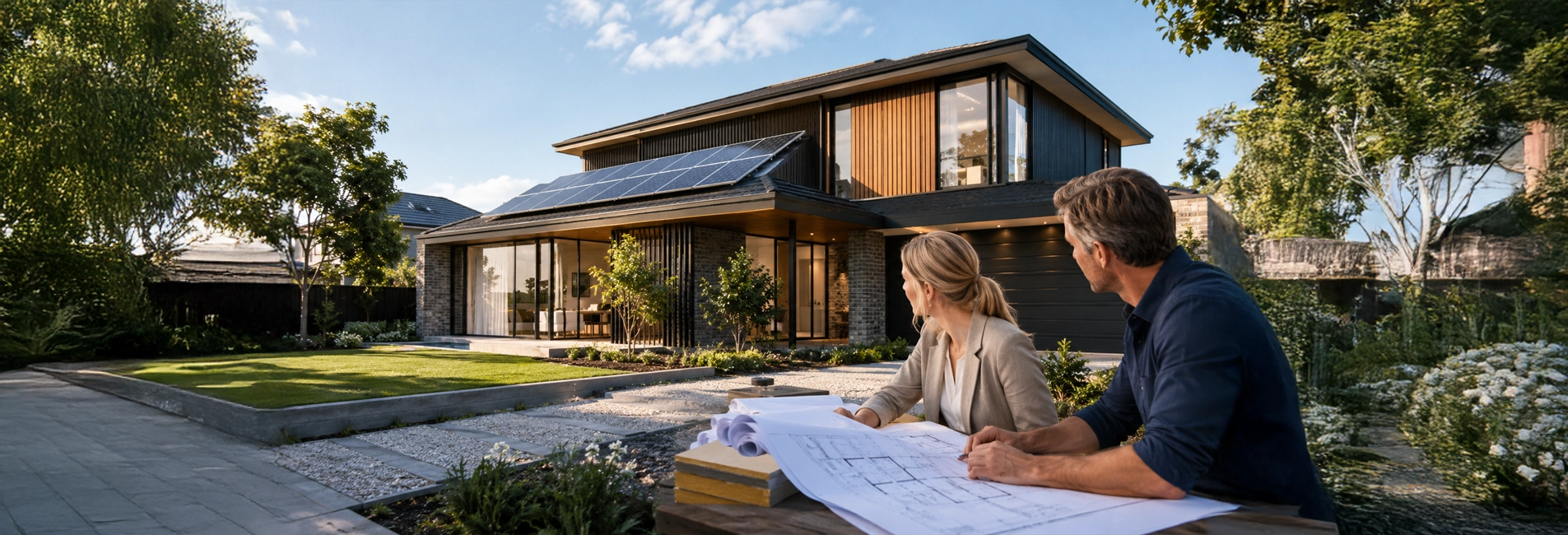
A building contract is a legal document that determines how much you pay, what you get, and what happens when things don’t go to plan. For anyone comparing house builders, whether you’re looking at volume operators or boutique fixed price home builders in Melbourne, it’s also the document that shows whether a builder’s promises actually hold up. Most people spend more time reading a phone plan than they do reading their building contract. That’s a very expensive mistake, and it’s an easy one to avoid.
Why Reading Your Building Contract Matters More Than Anything Else
In Melbourne’s residential building market, budget blowouts rarely happen because the builder is dishonest. They happen because the buyer didn’t understand what the contract actually said. A vague inclusion list, a handful of provisional sums, and a loose variation policy can add a significant, avoidable amount to a build, all of it technically above board, all of it in the contract you signed.
The good news is that building contracts aren’t that complicated once you know what to look for. This guide walks you through every section that matters, what it means, what the risk is, and what a good answer looks like.
Whether you’re dealing with a volume builder, a boutique residential builder, or exploring fixed price home builders in Melbourne, the contract is where everything is either protected or left wide open.
In Victoria, domestic building contracts are governed by the Domestic Building Contracts Act 1995 (VIC). This Act sets out requirements for domestic building contracts, including rules around progress payments, cost escalation provisions, and the builder’s obligation to provide a signed copy of the contract before work begins. Familiarise yourself with it at Consumer Affairs Victoria.
Building Contract Terms Every Buyer Needs to Understand
Before you can read a contract properly, you need to know what the key terms actually mean. Here’s the plain-English version of the language that determines your financial exposure.
Fixed Price Contract
The total construction cost is locked in before building begins. That number cannot change due to material cost increases or standard site conditions. A genuine fixed price contract gives you complete budget certainty from day one.
→ Ask: “Is this price fixed in writing, with no provisional sums?”
Provisional Sums
A provisional sum is a builder’s estimate for work that hasn’t been fully scoped. Common items include site costs, drainage, earthworks, and service connections. They are not fixed, and in practice they almost always increase once the actual work is assessed.
→ Any provisional sum in your contract is a potential cost blowout. Ask for fixed amounts on every line.
Inclusions List
A document listing exactly what is and isn’t included in the contract price, flooring, kitchen fittings, lighting, bathroom tapware, appliances, and so on. The inclusions list is your single most important reference document. If it’s vague, ask for specifics. If you can’t get specifics, walk away.
→ Request a full written inclusion list before you sign anything. Not after, before
Variation Costs
A variation is any change to the agreed scope after the contract is signed. Every variation attracts a cost, covering labour, materials, and admin. Even minor changes like shifting a door or swapping a tap can generate a variation invoice that feels wildly disproportionate to the change itself.
→ Lock in every decision before signing. Once you’re in the build, changing your mind is expensive.
Site Costs
Costs associated with preparing the land for construction, soil testing, levelling, retaining walls, and drainage. These vary dramatically depending on the block and are one of the most common sources of post-contract surprises when a builder uses a “site allowance” instead of a fixed site cost.
→ Ask whether the site has been assessed. If not, demand it before signing.
Progress Payments
Instead of paying everything upfront, you pay the builder in stages as the work moves forward. The Domestic Building Contracts Act 1995 (VIC) sets the framework, most Victorian builds follow six milestones: deposit, base (slab), frame, lock-up, fixing, and final. Exact amounts vary by contract.
→ Each progress payment stage should be clearly defined in your contract before work starts.
Building Permit
Think of it as the green light before anything gets built. A registered building surveyor checks your plans stack up against the National Construction Code and Australian Standards, then issues the permit. In Victoria, your builder usually handles this, but before you sign, ask who’s responsible for it and whether the fee is already in your contract price.
→ Ask who obtains the building permit and whether the associated fee is included in your contract price.
Building Specifications
A detailed technical description of the materials, workmanship, and methods to be used in the build. Specifications sit alongside the plans and form part of the contract. Vague specifications are a common source of disputes, “standard quality” means nothing without a specific product listed.
→ Review the specifications page carefully. If product names and grades aren’t listed, push for them.
How to Read Each Section of a Building Contract
A standard Victorian domestic building contract has several distinct sections. Here’s what to look at and what to look for in each one.
Contract Price & Fixed Price Clause
The single most important page. The contract price should be a firm, fixed number. Look for any clause that allows the price to be adjusted, such as cost escalation provisions, prime cost items, or provisional sums. If any of these appear, the price is not truly fixed. A genuine fixed price contract has none of these.
Inclusions List & Building Specifications
Every item included in the build should be specifically listed with product names, grades, or standards. Watch for generic descriptions like “standard kitchen” or “builder’s range tiles.” These give the builder discretion you’re paying them not to have. Ask for brand names, product codes, or specification references.
Provisional Sums & Prime Cost Items
Prime cost items are similar to provisional sums; they’re allowances for specific fixtures (like a particular range hood or tiles) where the final product hasn’t been selected. Both can increase. Push to convert every provisional sum and prime cost item to a fixed amount before signing.
Site Costs Clause
This section covers what assumptions the builder has made about your block. If it references a “standard site” or a “flat, accessible block with class M soil,” and your block doesn’t match, the difference becomes your problem. A good builder conducts a site assessment before quoting and includes the result in the fixed price.
Variation Policy
Defines how changes are handled after signing. Look for: how variations are priced (fixed rate or time-and-materials), whether there’s a minimum variation charge, and who has the authority to approve them. Avoid any contract that allows the builder to substitute materials without your written approval.
Progress Payments Schedule
This section spells out when you pay and how much. Victorian law regulates progress payments, but the exact breakdown still varies between contracts, so read it carefully. Each payment should be tied to a specific construction stage, not something woolly like ‘substantial progress.’ And don’t pay a cent ahead of the agreed milestone, no matter how much you’re asked.
Engineering Requirements & Council Approvals
Covers structural engineering, soil reports, and any council-specific requirements. In some Melbourne estates, developer guidelines impose additional engineering requirements or specific façade treatments. Confirm whether these costs are included in the contract price or treated as a provisional sum.
Energy Rating Requirements
Under the National Construction Code, new homes in Victoria must meet a minimum 7-star NatHERS energy rating. Your contract should confirm that the design meets this requirement. If upgrades are needed to achieve compliance, those costs should be included in the fixed price, not added later as a variation.
Developer Guidelines Compliance
New estates often have Design and Construction Guidelines set by the land developer, covering façade materials, colour palettes, fencing requirements, and landscaping standards. Make sure your builder is familiar with the specific guidelines for your estate and that compliance costs are built into the contract price.
Progress Payments in a Victorian Build: What Happens at Each Stage
Progress payments are how construction costs are drawn down over the life of the build. You don’t pay everything up front; you pay at each construction milestone. Here’s what each stage typically covers in a standard Victorian residential build.
1
Deposit
Paid at contract signing. Under the Domestic Building Contracts Act 1995 (VIC), the deposit amount is capped by law. This is regulated; any builder asking for more is outside the Act.
Regulated deposit
2
Base Stage (Slab)
Paid when the concrete slab is poured and cured. The base stage is typically the largest single progress payment in a single-storey build. Before releasing this payment, confirm the slab is complete and passes inspection.
Inspect before paying
3
Frame Stage
Paid when the structural frame is complete, and the building surveyor has carried out a frame inspection. The frame stage is when the home’s footprint becomes visible, a good time to walk the site and check that dimensions match the plans.
Inspect before paying
4
Lock-Up Stage
Paid when the external walls, roof, windows, and external doors are in place, the home is now “locked up.” At this point, the structure is weatherproof, and internal fit-out can begin.
Inspect before paying
5
Fixing Stage
Paid when internal fit-out is complete, flooring, cabinetry, internal doors, bath, and kitchen fixtures installed. This is when the home starts to look like a home. Walk through carefully and note anything that doesn’t match your inclusion list.
Check against the inclusion list
6
Final Payment (Completion)
Paid at practical completion, when the building permit authority has issued the occupancy permit. Do a thorough final walkthrough with your builder before releasing the final payment. Note every defect or outstanding item in writing before handing over the last dollar.
Don’t pay until defects are noted
Never release a progress payment until you have independently confirmed the relevant construction stage is genuinely complete. If you’re unsure, engage a private building inspector to review each stage before payment. The cost of an inspection is far less than the cost of discovering issues after the fact.
Fixed Price in Writing, Before We Start
At Truland Homes, your price is confirmed in writing before construction begins. That number doesn’t move. No surprise site costs, no mid-build variation invoices, no awkward conversations at handover.
Contract Red Flags That Tell You to Walk Away
When you’re comparing builders in Melbourne, the cheapest quote often contains the most red flags. Here’s what to watch for, and what it means in plain language.
Site costs subject to soil report"
Site costs haven’t been calculated. The provisional sum in the contract is a guess — and it will almost certainly increase once the actual assessment is done after you’ve signed.
"Builder's range" finishes throughout
No specific products are locked in. The builder can substitute with whatever is cheapest or easiest to source at the time. What you saw in the display centre may not be what you get.
"To be confirmed" in the inclusions list
Variations charged at "cost plus margin"
No mention of energy rating requirements
Developer guideline compliance excluded
No building permit fee listed
| Red Flag in the Contract | What It Actually Means |
|---|---|
| Site costs subject to soil report | Site costs haven't been calculated. The provisional sum in the contract is a guess, and it will almost certainly increase once the actual assessment is done after you've signed. |
| "Builder's range" finishes throughout | No specific products are locked in. The builder can substitute with whatever is cheapest or easiest to source at the time. What you saw in the display centre may not be what you get. |
| "To be confirmed" in the inclusions list | Items are unresolved. You're signing a contract with gaps in it. Those gaps will be filled later — at a price that's now in the builder's favour, not yours. |
| Variations charged at "cost plus margin" | The builder calculates the variation cost after the fact, adds their margin, and invoices you. You have no advance knowledge of what a variation will cost before you request one. |
| No mention of energy rating requirements | In Victoria, new homes must achieve a minimum 7-star NatHERS rating under the National Construction Code. If your contract doesn't mention this, ask how compliance is achieved and whether any related costs are included. |
| Developer guideline compliance excluded | New estates in Melbourne's south-east including estates in Cranbourne,Clyde,Officer and Pakenham have specific developer guidelines covering facade materials, landscaping and fencing. If these requirements aren't addressed in the contract, associated costs may fall to you post-signing. |
| No building permit fee listed | A building permit is a mandatory requirement. If the fee isn't in the contract, ask where it appears. "It'll be sorted out later" is not an acceptable answer. |
Understanding the Tender Process, New Home Builders in Melbourne
The tender process is the period between your initial enquiry and the signing of a formal building contract. For new home builders in Melbourne, this typically involves a preliminary agreement, a site assessment, the preparation of plans and specifications, and a formal tender, a detailed quote with full documentation attached.
A good tender from a reputable new home builder in Melbourne includes:
Fixed contract price, confirmed in writing, based on completed plans and specifications, with no open-ended provisional sums
Completed site assessment, site conditions factored into the quoted price, not left as an allowance
Full inclusions schedule, every item named, not described generically
Energy rating confirmation, 7-star NatHERS compliance confirmed as achievable within the design and included in the contract price
Developer guidelines review, builder confirms familiarity with your estate’s design guidelines and that compliance requirements are priced in
Building permit fee, the cost of obtaining the building permit is included or clearly itemised
Council approvals responsibility, clear statement of who manages council approvals and associated costs
Progress payment schedule, each milestone is defined clearly with the amount payable at each stage
As outlined on the Truland Homes building process page, inclusions, pricing, and timeline are all confirmed upfront, no variations, no hidden costs, and no decisions sprung on you mid-build. That’s what a legitimate tender process looks like. Your questions should be answered clearly before a contract is in front of you, not after. Before signing any building contract, it is also recommended to have it reviewed by a solicitor or conveyancer. Understanding the contract yourself is important. Still, a regulatory professional provides an additional layer of protection.
What Separates the Best Builders in Melbourne When It Comes to Contracts
There’s no shortage of builders in Melbourne, from top home builders operating at volume to smaller boutique residential builders. But the best builders in Melbourne all have one thing in common before you even look at their display homes: their contracts are clean.
What a Clean Contract Looks Like
A clean building contract from a trustworthy Melbourne house builder:
Your total cost should be confirmed before construction begins, not as an estimate, but as a written commitment. Truland Homes confirms your fixed price before signing, with no variation invoices and no surprise site costs.
States a fixed price with no cost escalation clauses
Lists every inclusion with product specifics, not generic descriptions
Contains zero provisional sums or prime cost items
Includes a site assessment result that informed the contract price
Clearly states the variation policy with a schedule of charges
Defines each progress payment milestone precisely
Confirms energy rating requirements are met within the design
Confirms compliance with developer guidelines for the specific estate
States who is responsible for council approvals and what it costs
Includes the builder's BPC registration number
- Check BPC registration at vba.vic.gov.au (VBA website hosts BPC services during transition)
- Confirm HIA or Master Builders Australia membership
- Read Google Reviews, not just testimonials on the builder’s own website
- Ask for references from builds completed in the past 12 months
- Review Consumer Affairs Victoria’s guide at consumer.vic.gov.au
Conclusion
A building contract isn’t just paperwork; it’s the document that determines every dollar you spend from deposit to handover. Understanding what a fixed price contract actually means, how provisional sums expose you to cost blowouts, what site costs are based on, and when progress payments are legitimately due, this is what separates buyers who get what they expected from those who don’t.
The builders who make this easy are the ones who explain the contract clearly before asking you to sign it, who conduct a proper site assessment before confirming a price, and who have no provisional sums, no variation invoices mid-build, and no surprises at handover. That’s not exceptional in the building industry; it’s what it should look like.
If you’re building a new home and want to know exactly what your Melbourne house builders are contractually committed to before you put pen to paper, start a conversation with a team that operates that way from day one.
Frequently Asked Questions
What are provisional sums in a building contract?
Provisional sums are estimated costs in a contract for work that hasn’t been fully scoped, such as site preparation, drainage, or utility connections. They are not fixed amounts. Once the actual work is assessed and carried out, provisional sums are reconciled against the real cost, and in practice, they almost always increase. A genuine fixed price contract should contain no provisional sums.
What are variation costs, and how do I avoid them?
A variation is any change to the agreed scope of work after the contract is signed. Variation costs cover the labour, materials, and administration involved in making the change. Even small changes can attract significant fees. The best way to avoid variation costs is to finalise every design decision before signing, and to choose a builder whose process actively supports this, rather than encouraging post-contract upgrades.
What are progress payments, and how are they regulated in Victoria?
Progress payments are milestone-based payments made at defined stages of construction, typically deposit, base (slab), frame, lock-up, fixing, and final. Under the Domestic Building Contracts Act 1995 (VIC), the deposit amount payable at contract signing is capped by law. Each payment should be tied to a clearly defined construction stage, confirmed in writing before you sign the contract.
What energy rating is required for new homes in Victoria?
Under the National Construction Code, new homes in Victoria must achieve a minimum 7-star NatHERS (Nationwide House Energy Rating Scheme) energy rating. Your building contract should confirm that the design meets this requirement. If upgrades are needed to achieve compliance, such as additional insulation or glazing, those costs should be included in the fixed contract price, not added later as a variation.
How do I check if a builder is registered in Victoria?
All domestic builders in Victoria must hold a current registration with the Building and Plumbing Commission (BPC), Victoria’s building regulator, since 1 July 2025. Registration is still verified at vba.vic.gov.au, which continues to host services during the transition to a fully integrated BPC website. Do this before signing any contract, regardless of how many referrals you’ve received or how impressive their display home looks.
Talk to Our Team Today
Our team walks you through every line of the contract before you sign, what’s fixed, what’s included, what the process looks like, and what happens if anything changes. No pressure. No surprises.